


Coaching Athletes
to Zone To Order the Kindle version of the book, click on this link: http://www.amazon.com/dp/B00IOTX3IA “In The Zone highlights a fascinating blend of practical and psychological concepts. Tim and Michael bring these key concepts to life with their model of 13 specific mental skills for all high achievers to strive for in their quest for success. The book also offers an engaging insight into the mental toughness of some of South Africa’s best athletes and would help anyone looking to improve their own performance.” "I enjoyed reading
this book of Mike and Tim. As a Sports Psychologist it gave me
the opportunity to assist players and coaches getting into the
zone. It also challenged me in asking meaningful questions while
trying to improve performances of athletes. I believe coaches
and players on all levels must read this book in striving for
excellence in sport and life." " 'In the Zone' is
a significant leap forward for the fields of sport, professional
coaching and also Neuro-Semantics. Detailing the mental and emotional
strategies of some of the world most elite sports people, this
book is an essential resources and handbook for any coach, leader,
athlete or sports coach who is committed to replicating consistent
states of top performance."
Michelle Duval, International Master Coach and founding CEO of
Equilibrio, Australia "If you are interested
in elite sport it is a treat to read a work that is localised,
yet internationally relevant and does talk of the sharp end of
sport. Even if you are not interested in the theory, the profiles
are thoroughly fascinating. SA Sport needs more books like this" In the book you will find 17 interviews
with some of South Africa's superstars, as well as an in-depth analysis
of the mental skills that supported such consistently high levels of
performance. "This book is a compilation
of stories, events and information that is unique in the world
of sport; you won't find this type of information anywhere else...
As such this book will enlighten, entertain and inspire all who
read it...I recommend the authors' work to any aspiring individual
or team looking to find the edge." "Now, in this
book, Mike Cooper and Tim Goodenough have taken all that I came
up with in Neuro-Semantics about being in the zone to the next
level. Here they have created a breakthrough model in their 13
steps to the zone...The
most significant contribution that Mike Cooper and Tim Goodenough
make in this book is precisely this - how to switch on the zone.
To that end they have identified how to get into the zone in a
step-by-step process... The central focus of this book offers
something brand new to the field." |
||
The Zoning Pyramid or Elite Athlete Development Model 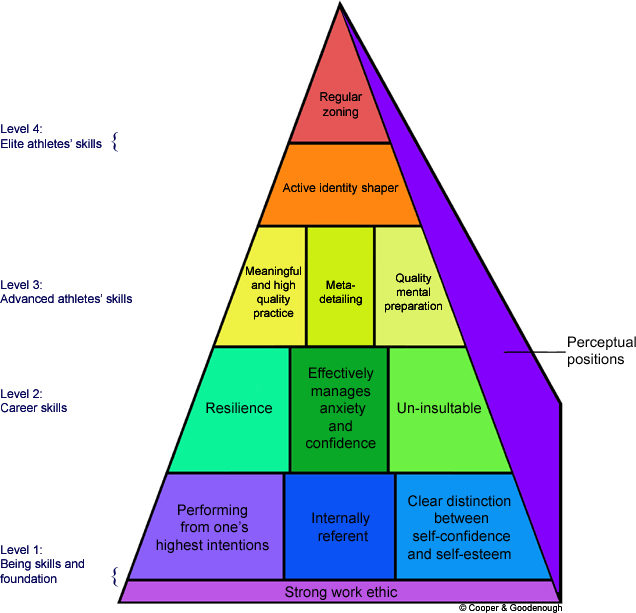 By placing the zoning skills in a pyramid we are aiming to demonstrate how the skills are interrelated. When we started our research it was all about “zoning,” the top of the pyramid. How does an athlete get there? As we interviewed more athletes we begun to realise that although being in the zone might only last 9.8 seconds as an example in a 100 metre race, the ability to zone at such an important moment required a lot more mental development then we had first imagined, in fact a total of 11 other skills were required for that level of performance. Due to the way these skills often combine to create other benefits, it was important to understand where to start developing skills, and how the skills are related to each other. Some skills you would find difficult to develop if some of the lower skills were not developed effectively. And so we designed a pyramid where each level rests on those below. To reach the top you need to climb the lower levels. Level 1: Being skills and foundation The first layer of the pyramid is work ethic. Nothing happens unless you work smart and hard in the sports world. It is the foundation as every other skill takes effort and commitment to build and apply. In the book we describe Performing from one’s highest intentions as skill 1 yet in the diagram, Strong Work Ethic underpins everything. The reason for the ordering is that whilst a strong work ethic is the most critical skill, it is from the performing from ones highest intentions skill that athletes get their motivation and energy to drive their strong work ethic and the development and use of the other skills in the pyramid. We debated a lot about whether the being skills should be at the bottom of the pyramid alongside the strong work ethic skill, but after reviewing all our interviews again it was clear having a strong work ethic is the cornerstone of every other skill. You may have fantastic mental skills, but unless you do anything with them, they will not support high performance. These skills are interesting as they are not just foundational skills for elite athletes but are foundational skills for every person who wants to succeed in life. We have found in our executive coaching practices that these four skills are also there in highly successful business men and women. The being skills are at the bottom of the pyramid, and once they are in place, the doing skills have a strong foundation to develop from. Level 2: Career Skills The next three mental skills are more specific for athletes. They will distinguish your committed athlete from the weekend sportsmen. But they take effort and work to practice till they are mastered. Level 3: Advanced athletes skills Athletes who have developed skills at this level
will typically be above average performers. Advanced athletes require
an incredible amount of discipline and effort, the challenge for athletes
at this level is to make this type of total personal commitment and
sacrifice that is required. Now the athlete can congruently and believably create an identity for themselves as an elite athlete and champion. Some never make the jump from level 3 to 4 where they can truly in their hearts see themselves as world beaters and champions. An athlete doesn’t need to have a world ranking as No 1 or even needed to have won the world championship to have this identity; he just needs to be No 1 in his own mind. With all these levels in place the athlete can create a space for himself where he can zone regularly and at will (the athlete would have been coached on how to do this) even when under tremendous pressure. Perceptual Positions This is the other side of the pyramid. This is often called the Captains skill. It is not a skill everyone will have to develop but anyone who plays in an individual sport or is a decision maker in a team will need it to be truly effective. In fact if you fall into this category and don’t have this skill it will stop you being able to perform optimally. To Order the book click on this link: http://www.kalahari.net/bk/product.asp?sku=30626164
|
 © Coaching Unity 2014 - All Rights Reserved


Check out Tim's Mental Toughness Blog at |
|---|